


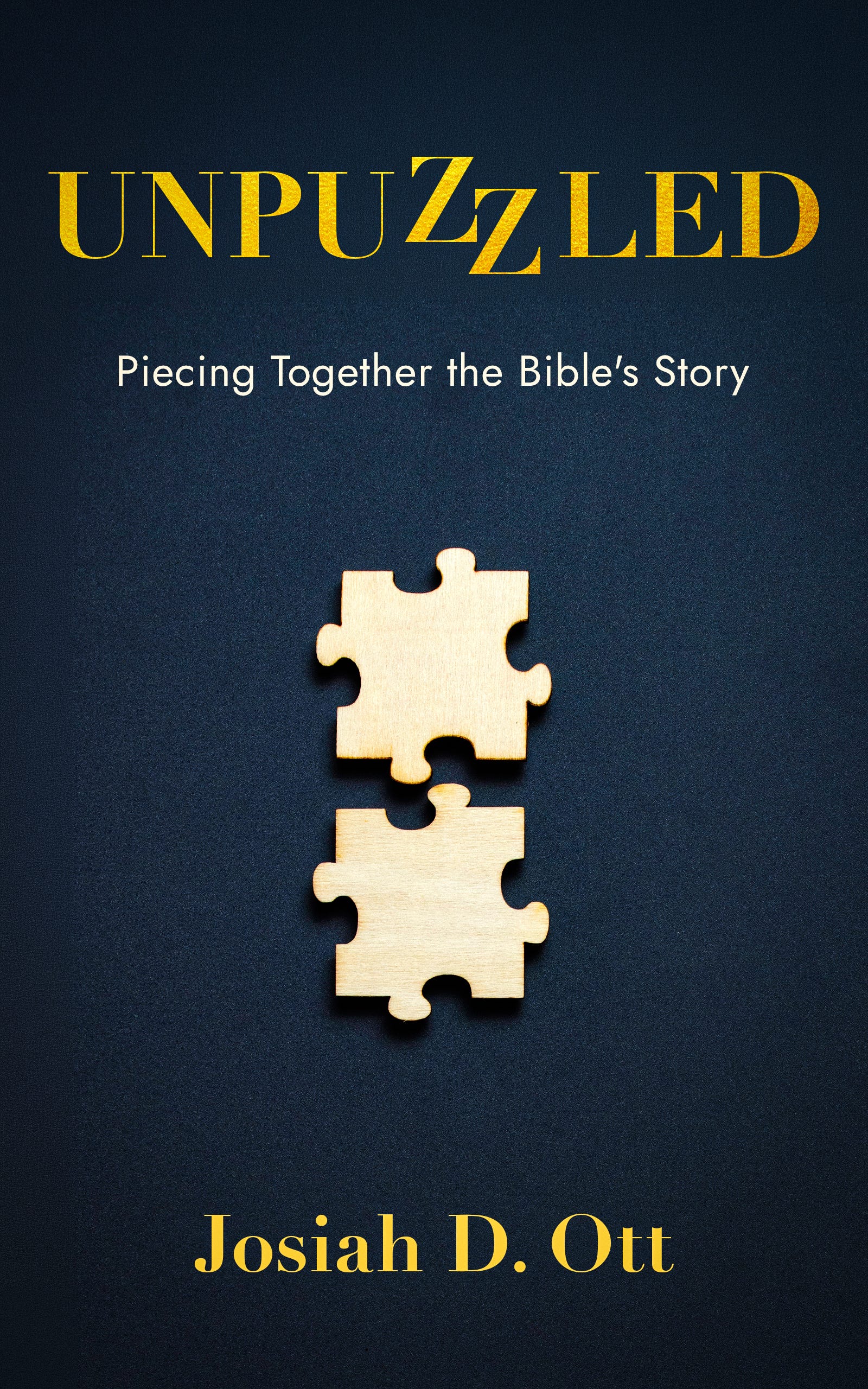
Unpuzzled is launching this upcoming Tuesday, December 1st! With this, I wanted to offer a preview to help orient you to the book. There are eleven chapters total that go from creation to new creation. The preface and chapter 1 help to essentially layout the book and orient you to its focus we get to summarizing the storyline. I wanted to offer them freely here.
I hope this work blesses you.
Preface: To the Reader
If you’ve ever put a puzzle together, you will know that one of the most important tools you have at your disposal is the box. Not solely for its capacity to contain the pieces, but for the picture it presents of the completed work. Personally, I’m not a big puzzle-person, but whenever I do puzzles, I am glued to the box.
Without a picture, if you were to pick up a black puzzle piece, it could be one thousand different things. Is it a picture of the night sky? Is it a spot on the back of a cow? Is it a car tire? Perhaps it’s a book?
Unless you can see the picture, you can only guess. I have actually used this illustration in person before to showcase this very reality, and I always find it fun to have people guess what they are looking at. My go-to puzzle is of cows in a field with a small selection of black cow pieces presented to the people. But apart from that knowledge, you have no context to begin your guessing with. So far, no one has guessed that they were looking at a cow.
Sadly, many people come to the Bible in the same way. They don’t have a picture of the Bible’s storyline that unites all of the different parts into a cohesive unit or picture. Perhaps, like me, they remember from Sunday school that David ran away from King Saul. Maybe they’ve always loved the story of Joseph going to Egypt. They’re probably familiar with Noah’s Ark and know there was a guy named Moses who said, “Let my people go!” Certainly, they’ve heard the name of Jesus. But then there’s a seemingly infinite number of background characters.
Worse yet, the books at times seem chronological, but then they’re not. You read through, and you’re sure you’ve read that story before elsewhere, somewhere for sure, and you don’t realize that multiple books might tell the same story. You’re looking at black puzzle pieces and aren’t sure where they fit. That is why I have written this work.
It’s hard to jump into a book as beautiful and complicated as the Bible without some framework upon which to build. With sixty-six books composing one big book, it’s no ordinary book, but let me encourage you: it’s not impossible to understand.
The goal of this work is to present to you, in less than two hours, an overarching view of the Bible’s entire storyline that comes from its own pages. What I am sharing isn’t alien to the Bible, but if you’ve never seen the picture before, it might seem new. This is simply a consolidation of years of reading and studying intended to make the Bible feel more accessible than ever before. With this, you can take these chapters individually, or you can take them as a collection. I would recommend you read through the entire thing before diving deeper into specific chapters.
All in all, I hope it helps you to learn the Bible’s story and, even more, to get to know the Author who is behind it all. There’s a purpose to the story, and there’s even a place where we fit in too.
First, let’s meet the Author.
Chapter 1: In the Beginning, God
“In the beginning, God created the heavens and the earth.”
—Genesis 1:1
The Bible is a big book composed of sixty-six smaller books contained within two testaments that tells one story—the story of God. Not the story of His origin, for He had no beginning, but a story of His acts and His progressive revelation of Himself to His creation. This God and His acts are, as it were, the puzzle picture that we’ve been looking for. God is the main character of the Bible; we should read it to know Him.
When the first act of the Bible opens, there is God. The metaphorical curtain is pulled back as the inspired narrator recounts, “In the beginning, God…” (Genesis 1:1). God is self-existent, meaning He relies on nothing else in order to exist. God had no origin. He has always been. Creation came to be, but God always was. That’s not easy for us to understand, but that’s where faith comes in. We must be willing to acknowledge at the outset that if God is our Creator and we are merely His creatures, He will be beyond our understanding in many ways. That’s okay. He is God. We are not.
Before we embark on our journey together through the Bible’s storyline, it is helpful to note, as one seminary professor made it known to me, that the Bible either teaches us about God or about our necessary response to Him. God is the Bible’s main character before any other. If we read the Bible and miss God, we’ve missed everything. This in mind, we must recognize that the goal of the Bible is to reveal its Author—God.
As such, the Bible is no normal book. For while it was physically penned by men, it originated in the mind of God and is a God-breathed book (2 Timothy 3:16-17). It is intended to reveal Him, and we get to hear the Author as His Spirit breathes upon His Word.
In the Beginning
The Bible from the outset presents that it was this God who created all things. The first “piece” to grasp is that God is our Creator. In the Genesis creation account, God brings all things into existence through His spoken word (Genesis 1:1-27). Then, throughout the Bible, in various picturesque ways, His work of creation is retold. The takeaway for us is that He is the One who has made all things, including us—as such, He has a rightful claim on our lives.
Just as an inventor has the rights not only to patent his work, but also to establish its proper use, so it is with God and humankind. I could technically use a camera as a hammer, but everyone would know that isn’t what the camera was designed to do. It’s great at taking pictures, but not so great at driving nails.
So it is with people. God, as our Creator, made us for a specific purpose. It has been popularly summed up as “Knowing God and making Him known.” I find that helpful.
God created human beings to know Him in covenant relationship. In the initial creation, there is a picture of God walking in the Garden of Eden in the cool of the day (Genesis 3:8). Apparently, that must have been His custom. In paradise, God and man dwelt together in perfect harmony.
God made human beings in His image or likeness (Genesis 1:27). Essentially, we were made to be God’s representatives on the earth who would rule the created order on His behalf. God told Adam to subdue the earth and to have dominion over all the living creatures on the earth that He made (Genesis 1:28).
Humankind’s creation in the image of God is altogether unique from the rest of creation. People have the special capacity to relate to both the creature and the divine. Human beings alone are able to connect with God and to worship in this way.
Fascinatingly, animals are simply subjects of their surroundings and cannot comprehend on a higher level the glory of the One who made these things. Human beings stop at waterfalls in awe; animals stop there to get a drink.
God’s Present Work: Providence
Beyond the initial creation, it is helpful to see that throughout the Bible’s storyline, God is actively guiding His creation along towards its intended end. Theologians have helpfully termed this “providence,” which essentially describes God’s governance of His creation. I like to think of providence as the divine fingerprints that are all over the Bible’s story and our stories as well. If you’ve ever had a coincidence in your life that just seemed a bit too perfect to be a result of mere chance, that’s not coincidence—that’s providence.
Now, you won’t find the word “providence” in the Bible. It’s simply a term that is helpful to describe this act of God that we do see throughout the Bible. It reminds us that He is at work behind the scenes in all things, even if we might not see His name written in the clouds.
A great example comes much later in the Bible, in the book of Esther. God isn’t directly mentioned or referenced even one time in the entire book! Yet if your eyes are open, He is clearly there all along. A helpful verse to navigate this reality is found in the book of Romans:
And we know that for those who love God all things work together for good, for those who are called according to his purpose (Romans 8:28).
Things in life obviously don’t work themselves; it is God who is at work in all things according to His plan.
With these concepts in mind, before we begin tracing the Bible’s storyline through the rest of this book, we must see that history is not repeating itself in endless circuits. History isn’t circular; it is linear. It had a definite beginning and is moving along a God-ordained course towards His intended end. The story begins with a good creation that is tarnished by the fall of mankind. It then introduces God’s plan of redemption and culminates with a new, restored creation.
For now, we must know that as we follow the Bible’s story, we aren’t following a set of chance events and random characters but countless things that were planned by their Creator for His glory and the good of His creatures. Altogether, they are creating a beautiful picture that shows us what God is like as we read of His acts. The task for the reader then is to see how these things piece together so that the picture God is creating can be seen and understood.
The Glory of God, A Revelation of Who God Is
As we close this chapter about God, we must also know that there is a purpose to Him being the main character. His work of creation and His present work of providence should evoke a response in us. For all things were made that we might worship God and give Him glory.
The word glory in the Old Testament usually refers to the weight of something, or something heavy. In speaking of God, we could think of it as God’s reputation for greatness. It is His fame and majesty that by nature demand worship. With this in mind, He wants His reputation as our Creator to be on full display as we seek to glorify Him as He made us to.
Throughout the ages, God has progressively revealed Himself for the purpose of the glory of His name and of His grace. He is not just “god” generically—He is Yahweh. He is the living God. A God who is ultimately revealed in Jesus Christ, the eternal Word of God (John 1:18). We’ll see this much later as His glory is unveiled more clearly and greatly. These things continue the movement of history towards a final revelation of God’s glory as He predicted long ago:
For the earth will be filled with the knowledge of the glory of the Lord as the waters cover the sea (Habakkuk 2:14).
Ultimately, our purpose is for the glory of this God, and it is in this sense that we are actually a part of this same story that God has been telling from the beginning.
As we dive into the coming chapters, I pray that you will clearly see this beautiful story that God has been writing for millennia. I pray that you will see how each piece of the puzzle fits within the whole. Then, most of all, I pray that you will see how these things reveal who God is and what He is like.
Chapter Takeaway:
God is the main character of the Bible. We should read it to know Him.
Reflection Questions:
1. What do you think of seeing God as the main character of the Bible? Does that change how you read it?2. How have you seen the fingerprints of God in your own life?